
The Complete Larimar Jewelry Buying Guide
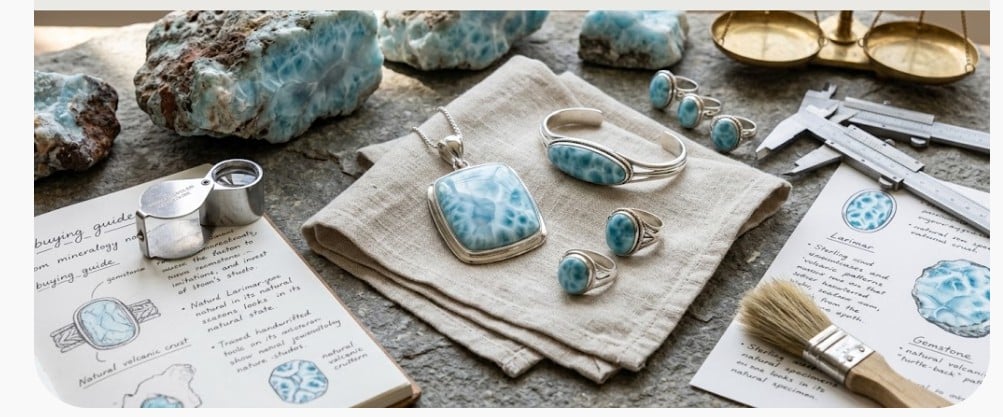
Like most things in life, fine jewelry comes in different tiers. There will always be accessible entry-level options and high-end collector grades, and true Dominican Larimar is no exception. A smaller, paler natural stone set simply can be a lovely, budget-friendly purchase.
This guide isn’t about judging price points—it’s about protecting you from fake stones, fake precious metals and misleading claims.
Because authentic Larimar is mined from only one location on Earth, its global popularity has triggered a surge of plastic resin copies, dyed stones, and deceptive shortcuts. When shopping online, you cannot touch, weigh, or chemically test a piece before checkout; protecting your investment comes down to knowing how to read listing photos, evaluate realistic pricing, and spot vendor red flags.
Whether you are looking for an everyday silver pendant or a museum-grade collector’s piece, this guide will give you the practical knowledge to verify authenticity online, recognize durable craftsmanship, and invest in real Dominican Larimar with complete confidence.
Look for Natural Larimar
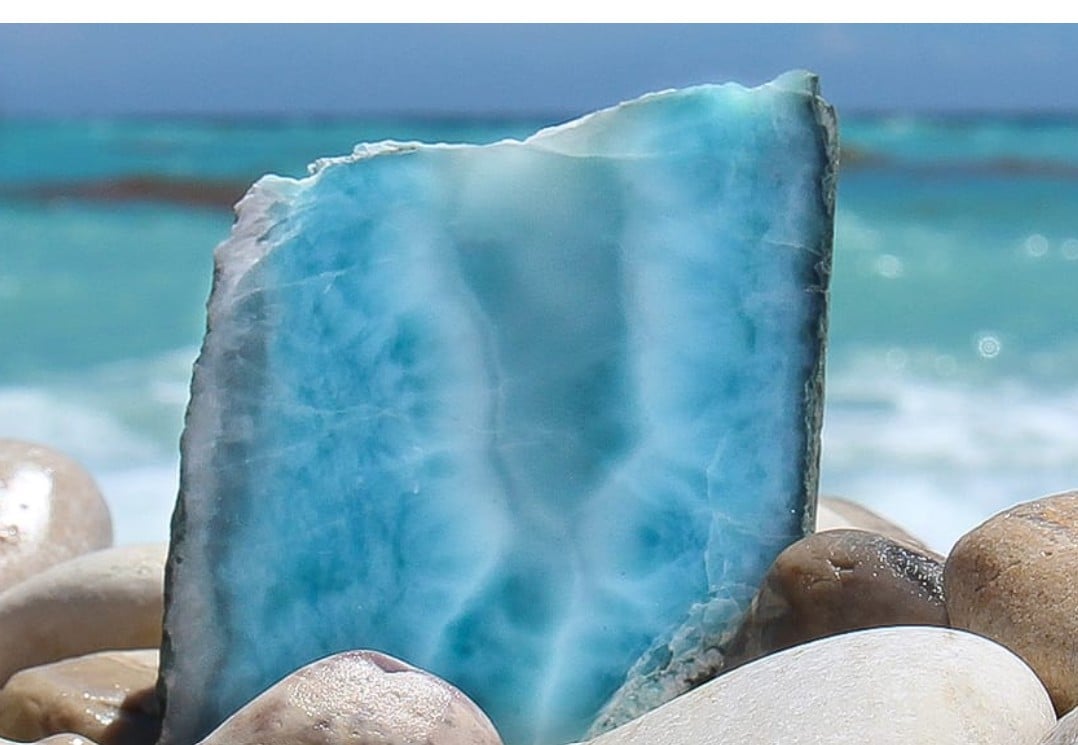
Inspect the Pattern (Clouds vs. Veins)
Real Larimar features organic, soft, sea-foam or cloud-like marbling with natural gradients between white and sky-blue. Red flag: If the piece shows dark, sharp, spiderweb-like lines, it is usually dyed howlite or turquoise imitation. If the blue is flat, electric neon, or completely solid with no depth, it is likely dyed stone, glass, or resin.
Watch for Repeating Patterns
Genuine Larimar is one-of-a-kind; no two cut stones share the same pattern. If a shop sells multiple quantities of an item showing the exact same pattern, or uses a manufacturer stock photo, you may receive a mass-produced resin fake.
Beware of Flat, Uniform Blues
Counterfeits made from dyed howlite, dyed magnesite, or opaque glass look completely uniform in tone. Real Larimar always exhibits natural variation, subtle tonal shifts, and organic white clouding. Dyed stones typically show color concentrating heavily in spider-web fissures or surface cracks where dye pooled. Real Larimar’s white patterns are crystalline and integrated deeply into the stone.
For more details on how to spot potentially fake Larimar, read this article.
The Unspoken Truth: Why Setting & Silverwork Matter Just as Much as the Stone
Most buying guides focus entirely on evaluating the blue cabochon, but the metal surrounding it determines whether your piece survives daily life or ends up broken in a jewelry box.
Natural Dominican Larimar is a fibrous gemstone, measuring roughly 4.5 to 5 on the Mohs hardness scale (similar to turquoise or lapis lazuli). It does not have the scratch-resistant resilience of a sapphire or diamond. When cutting corners, mass-market manufacturers often compromise on the metalwork to save silver weight and labor costs.
Before investing, examine the craftsmanship of the setting using these key indicators:
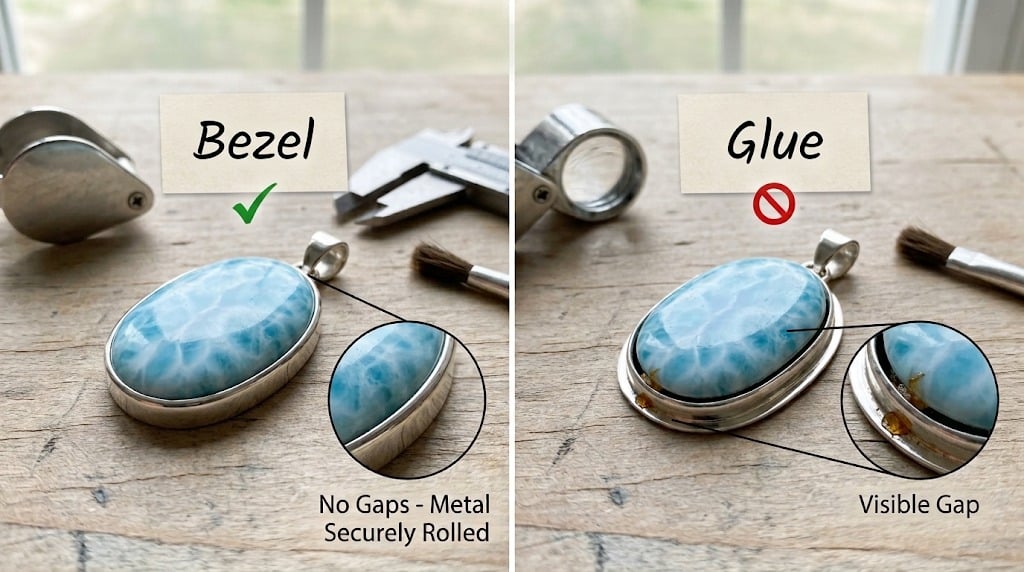
- The Hallmark of Fine Work (Full Bezel): Look for a continuous collar of solid sterling silver custom-shaped to the exact perimeter of the cabochon. A skilled metalsmith rolls and burnishes this silver lip directly over the edge, physically locking the stone into place without relying on adhesives. This metal buffer absorbs accidental bumps and protects the stone’s softer edges from chipping.
- The Cheap Alternative (Glue-and-Tray): Mass-produced souvenir jewelry often sets stones into generic, pre-cast shallow cups using epoxy. Over time, hand soap, shower steam, skin oils, and temperature shifts break down adhesive bonds.
- The Visual Check: Inspect the border under good light. A full bezel covers the edge of the stone, so if you notice a gap between the silver and the stone or amber colored glue remnants around the perimeter, it is held by adhesive.
Evaluate the Silverwork Craftsmanship
Stone Mounting
The setting isn’t just an aesthetic detail—it is the structural frame that dictates whether your piece lasts a lifetime or breaks after a few wears. Larimar requires thoughtful engineering to keep it safe and secure.
When inspecting how the stone is mounted, the gold standard is always a hand-pressed, full bezel setting. A bezel rolls genuine precious metal cleanly over the rim of the stone, shielding its vulnerable perimeter from bumps and knocks. If you want to see exactly how this metalwork works, check out our guide on what a bezel setting is and why it protects Larimar. On the flip side, watch out for glue-only settings. Cheap mountings often use quick-drying chemical adhesives that eventually dry out, turn yellow, and give way, sending your stone tumbling to the floor.
Prongs
Prong settings are notoriously prone to fail in sterling silver, particularly when paired with larger gems such as Larimar. Because silver is a softer, malleable metal, prongs bend and catch on sweaters or scarves with frustrating ease. Every snag pulls the prong further away from the stone, at worst causing complete failure and at best leaving its delicate edges exposed to direct impacts and chipping.
Gallery
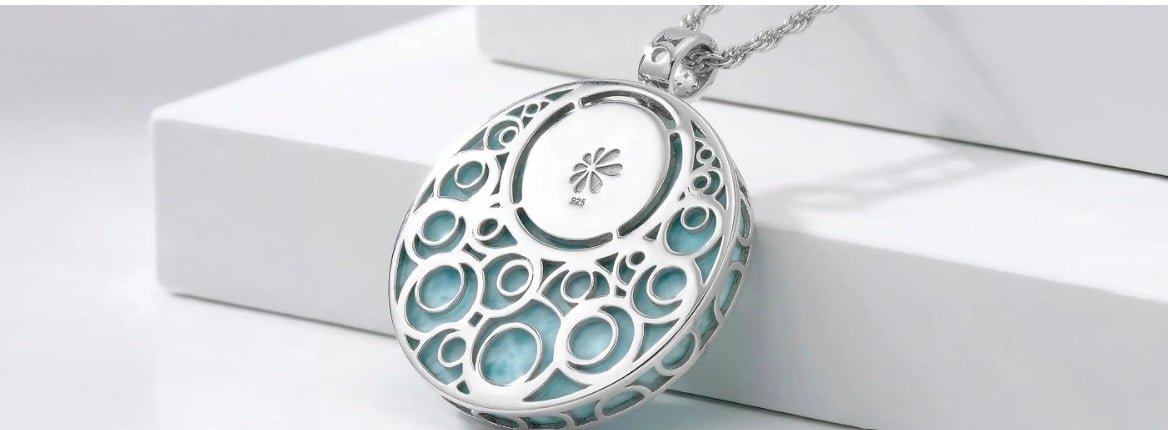
The back of the jewelry—known as the gallery—matters just as much as the front. Look for solid metal backings or sturdy, well-engineered cages that support the underside. A solid backplate creates a barrier against body oils and absorbs shock if the piece is dropped. Cheaply produced pieces frequently cut corners with hollowed-out, paper-thin backs to save on silver weight, leaving the gemstone dangerously unsupported and prone to popping out under gentle pressure.
Precious Metal
Pay close attention to the metal itself. Authentic, long-lasting jewelry uses solid .925 sterling silver, which should always feature a clear purity hallmark stamped into the metal. Be cautious of vague descriptions like "silver tone" or "Tibetan silver"—these are almost always base metals with a thin cosmetic wash that will peel, turn your skin green, and corrode over time.
Other Points to Consider
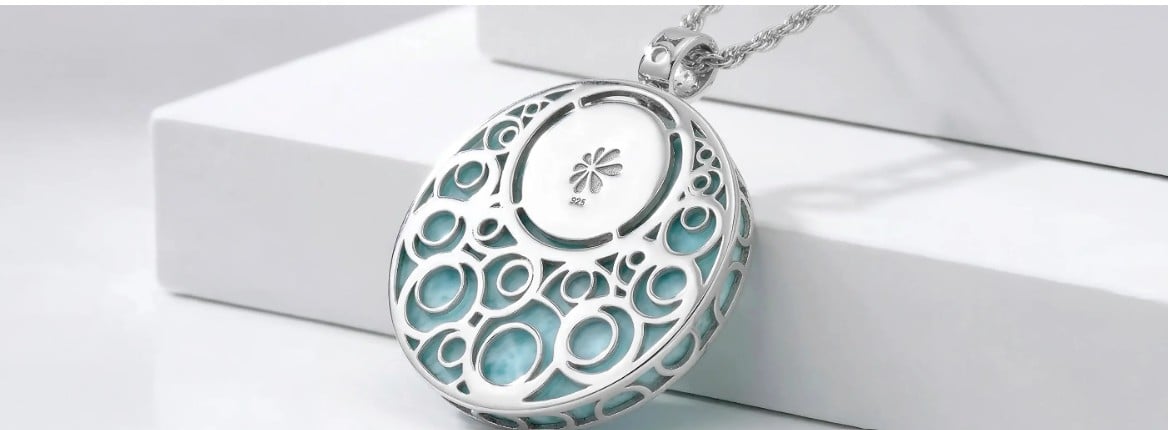
Watch for Stolen Brand Photography
Unscrupulous sellers frequently rip high-resolution product photos directly from established, reputable Larimar jewelry brands to advertise cheap counterfeit stones. If an unknown website, social media ad, or low-cost marketplace seller is using crisp, studio-grade imagery of a breathtaking stone—yet selling the piece for a fraction of the market price—they are baiting you with another company’s photo. What arrives in the mail will almost certainly be a cheap synthetic imitation or mass-produced dyed resin that looks nothing like the picture.
Beware of Misleading Mineral Names
Watch out for deceptive naming like "Caribbean Turquoise," "Dominican Turquoise," "Atlantis Stone," or "Ocean Calcite." Sellers often use these creative trade names to pass off cheap dyed minerals (like magnesite, calcite, or low-grade howlite) as Larimar.
Scrutinize Multiple Listings
Because no two Larimar stones in nature have identical wave patterns, a seller showing three separate items with the exact same stone pattern is selling factory-printed cast resin.
Consider Origin Transparency
Natural Larimar originates solely in the Dominican Republic. Sellers claiming origins in China, Brazil, India, or Mexico are selling lookalike stones (such as hemimorphite or dyed minerals).
Price Realism
Larimar mining involves hand-excavating deep vertical shafts into mountain volcanic deposits, and at today’s silver prices, $20 to $30 won't even cover the raw precious metal and benchwork needed for a quality piece of jewelry. Finished jewelry at that price point is almost guaranteed to be synthetic stones, low-grade reject Larimar or base metals in disguise.
Beware of Bait-and-Switch Sellers
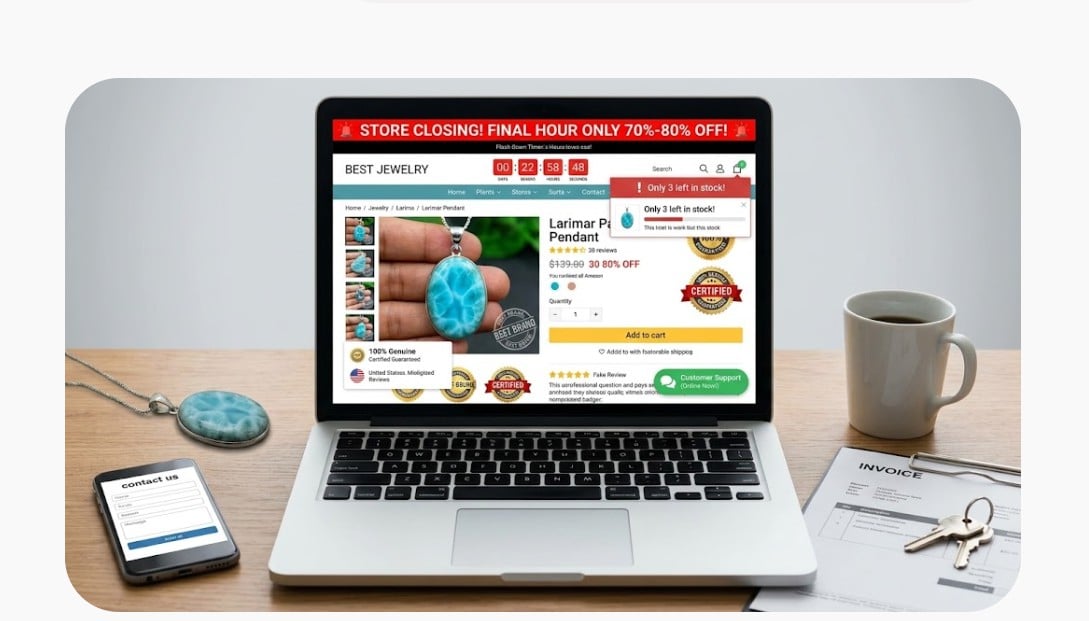
Because top-grade Dominican Larimar commands premium prices, dishonest retailers frequently photograph a single, museum-quality "hero" stone—or scrape professional imagery straight from established designer brands—to advertise their listings. When your order arrives, what is in the box is commercial-grade rough: pale, chalky, heavily fractured, or washed out with gray and muddy inclusions. Watch for these key red flags that may signal a low-trust operation:
- Anonymous "Contact Us" Pages: Legit jewelers provide a physical workshop or headquarters address, a direct phone number, and a verifiable business registration. If a website offers only a generic web form or an anonymous Gmail address, there is no real company standing behind the product.
- Mismatched Photography Styles Across Listings: If one product photo looks like a minimalist Scandinavian studio shoot, another carries the watermark of a known designer, and a third is an unedited phone snapshot on a kitchen counter, the seller does not own their inventory—they are scraping images from across the web.
- Massive, Permanent "70%–80% Off" Discounts: Genuine, top-grade Larimar is a finite, hand-mined resource with fixed baseline production costs. Retailers running permanent "store closing" or "flash sale" banners slashing prices from $250 down to $29 are using inflated, fake MSRP pricing to dump low-grade reject stones.
- Hidden Reviews and Disabled Comments: If a seller blocks public comments on their posts and has no presence on independent platforms like Google Reviews or Trustpilot, they are actively hiding real customer feedback.
- Concealed Shipping Origins and 3+ Week Delivery Windows: If an online shop claims to be a "local artisan studio" or "Caribbean boutique" yet quotes a 15–30 business day shipping window, you are dealing with an overseas dropshipper fulfilling orders with bulk factory scraps.
Your Questions Answered
How can you tell if Larimar is real when shopping online?
Look closely at high-resolution listing photos, pricing, and seller transparency. Authentic Larimar displays irregular, organic patterns resembling sunlight rippling through Caribbean water, with natural variations in blue tones, soft white clouding, and occasional red or brown mineral inclusions.
Beware of counterfeit red flags: unnaturally vibrant, uniform solid blues; dark spiderweb veins typical of dyed howlite; perfectly identical patterns across multiple pieces; and prices that seem too good to be true. Legitimate jewelers will display the exact stone you receive, explicitly guarantee natural Dominican Republic origin, state the setting metal (.925 sterling silver or solid gold), and offer an established return policy.
Is Larimar expensive?
The price of Larimar ranges from accessible everyday pieces to high-value collector items, depending on stone quality, rarity, and craftsmanship.
Because Larimar is found in only one square kilometer in the Dominican Republic, miners must dig deeper underground each year to reach viable veins, significantly increasing extraction difficulty and raw material costs. Only a small fraction of mined material meets jewelry standards. To create masterwork designs, artisans must sort through kilograms of raw stone over months just to find harmonized colors and patterns.
While limited natural reserves have steadily increased its market value, its diverse grading makes it accessible whether you are buying your first everyday pendant or investing in an heirloom statement piece.
Is Larimar fragile?
Larimar rates between 4.5 and 5 on the Mohs hardness scale, making it relatively soft compared to gemstones like diamonds or sapphires. It requires gentle handling to prevent surface scratches or chips from direct impact. Choosing protective settings like full bezels helps shield the stone's delicate edges during daily wear.
Can Larimar get wet?
Exposure to water will not harm Larimar, but prolonged submersion or exposure to harsh chemicals, saltwater, chlorine, and soap should be avoided. These can dull the stone's luster, weaken adhesives, or discolor the natural blue hues over time.
How should you clean and care for Larimar jewelry?
Clean Larimar gently using warm water and a soft-bristled brush or microfiber cloth. Avoid harsh chemical cleaners, steam cleaners, or ultrasonic devices, as these can damage the stone's delicate surface and natural luster.
Store your Larimar jewelry separately in a soft pouch to prevent scratches, and put on your jewelry after applying perfume, hairspray, or lotion.
What factors determine the value and grade of Larimar?
Larimar value is driven by color, pattern, clarity, and cut. Deep blue or intense sky-blue stones often feature heavy gray and brown mineral inclusions, rendering them an overall lower quality than a lighter stone with few impurities and inclusions.
Craftsmanship, stone size, and the quality of the precious metal setting also significantly influence the overall piece value.
Can you test Larimar authenticity at home?
While complete verification requires professional gemological testing, several visual and physical checks can help verify authenticity. Genuine Larimar feels cool to the touch, has a noticeable weight compared to resin or plastic counterfeits, and features irregular, multi-tonal blue patterns with subtle depth.
Under a magnifying loupe, real Larimar exhibits fine crystalline structures rather than the air bubbles or smooth uniformity typical of glass or synthetic imitations.
Discover the World of Larimar
Guides, insights, and inspiration to help you choose, understand, and care for this rare Caribbean gemstone.
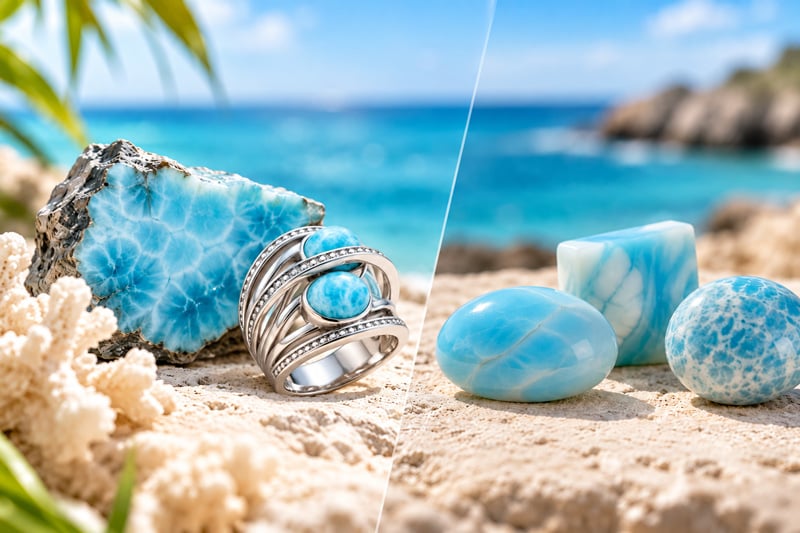
Real vs. Fake Larimar
Discover the key differences between genuine Larimar and imitations, and learn how to spot an authentic stone with confidence.
Read the Article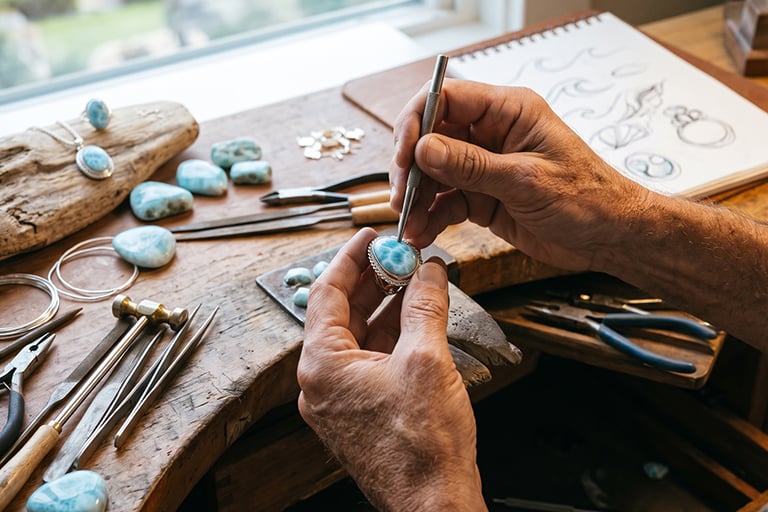
About Marahlago
Learn how our family-owned studio pairs the top 3% of natural Larimar with custom-engineered solid sterling silver.
Read the Article
The Energy of Larimar
Exploring the unique properties and metaphysical ways to use this rare ocean stone.
Read the Article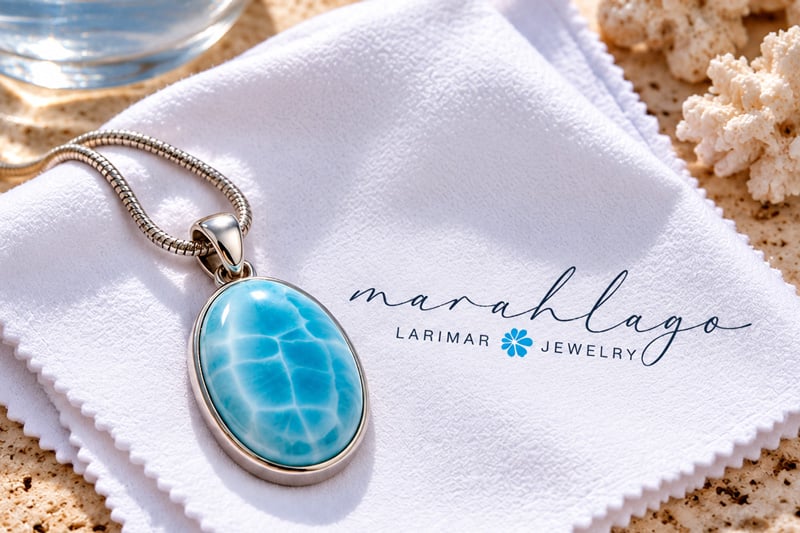
Larimar Care and Cleaning
Keep your Larimar jewelry looking beautiful for years to come with simple care tips, cleaning methods, and storage advice.
Read the Article