
How to Spot Real vs. Fake Larimar Online: The Buyer’s Guide
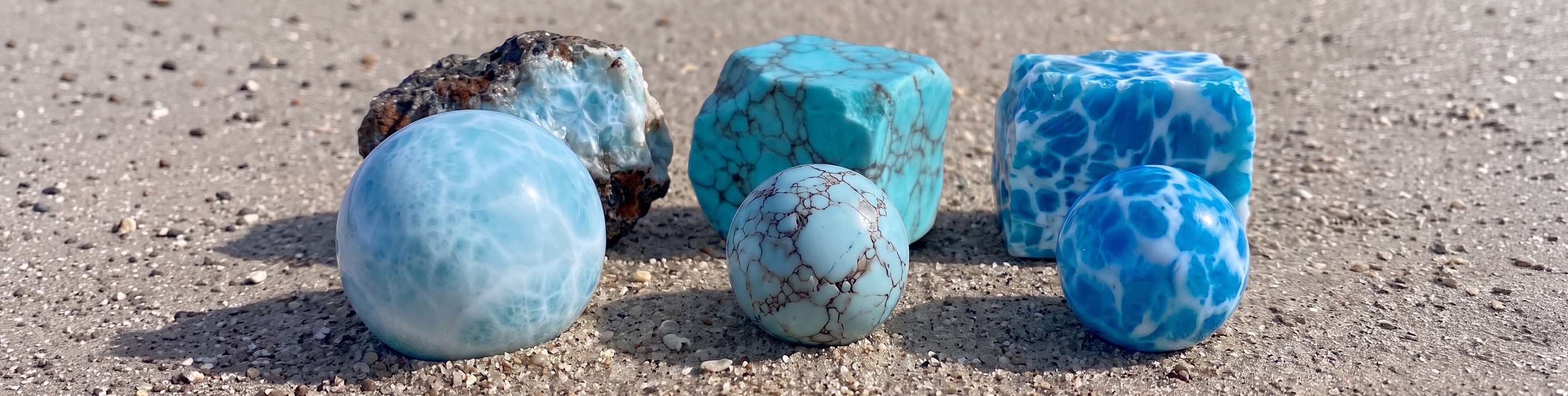
Because genuine Larimar (blue pectolite) comes from only one location on Earth—a single square-kilometer deposit in the Dominican Republic—it commands premium value. That extreme rarity makes it a prime target for counterfeiters online, where shoppers frequently encounter everything from dyed base minerals to synthetic resin and colored glass. Because you cannot touch or test a stone through a computer screen, identifying authentic Larimar online requires evaluating listing photography, pattern structure, and seller terminology.
What Counterfeit Larimar Looks Like Online
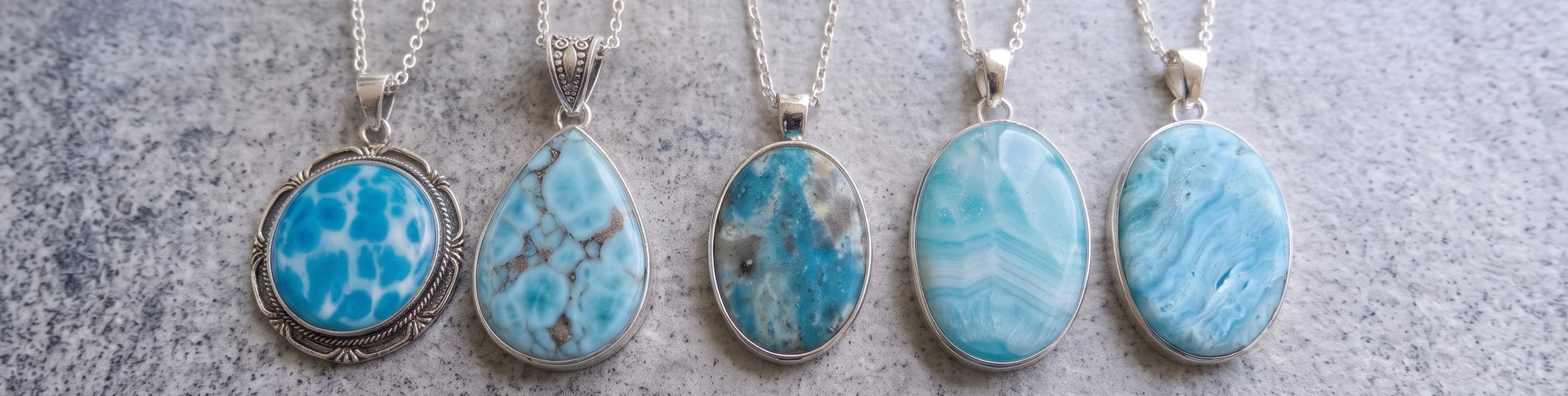
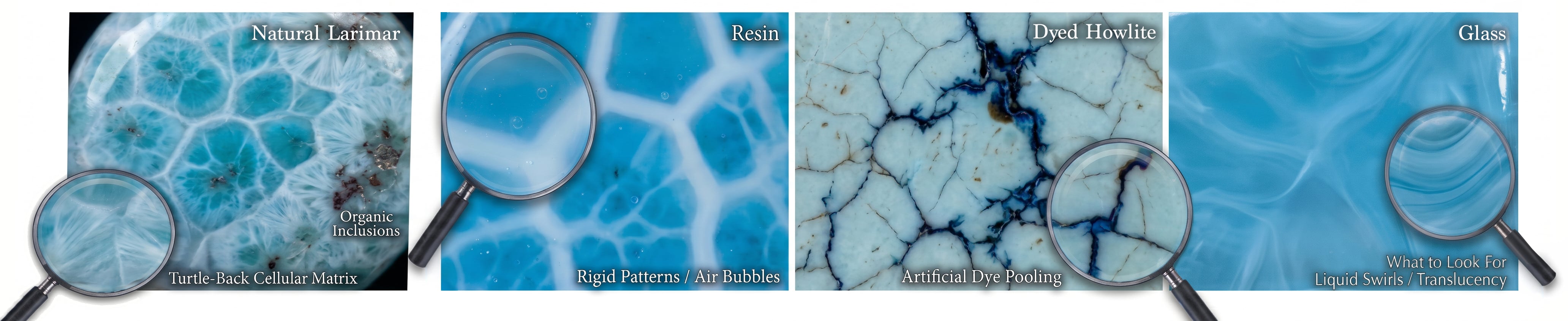
Dyed Howlite or Magnesite: These are inexpensive, naturally white, porous minerals that manufacturers artificially dye light blue. When evaluating photos online, focus closely on the veins and fissures. In dyed stones, the blue liquid pools heavily in every crack, making the matrix lines noticeably darker blue than the rest of the stone. Natural Larimar veins, by contrast, are white, reddish-brown, or gray.
Poured Resin and Plastic: These counterfeits are synthetic polymers cast into cabochons or drilled beads. Under camera lighting, they display repeating, artificial swirl patterns and completely lack the needle-like crystalline structure of real stone. Their surfaces often look waxy or unnaturally uniform, and careful inspection frequently reveals tiny trapped air bubbles.
"Larimar Quartz" and Glass: This category consists of colored glass or dyed chalcedony and agate. Rather than displaying the organic, cellular matrix of genuine pectolite, these pieces exhibit translucent, glassy clarity or distinctive concentric, circular banding typical of agate formations.
Reconstituted Material: Reconstituted pieces are made from crushed low-grade mineral dust bound together with colored resin. They are basically resin with some dust added as filler so the manufacturer can advertise the piece as containing actual Larimar. The biggest giveaway is uniformity: if a vendor offers many listings displaying almost identical cloud patterns, exact matching shades, and perfectly symmetrical shapes, the material is mass-produced and synthetic.
Misleading Listing Terms to Avoid
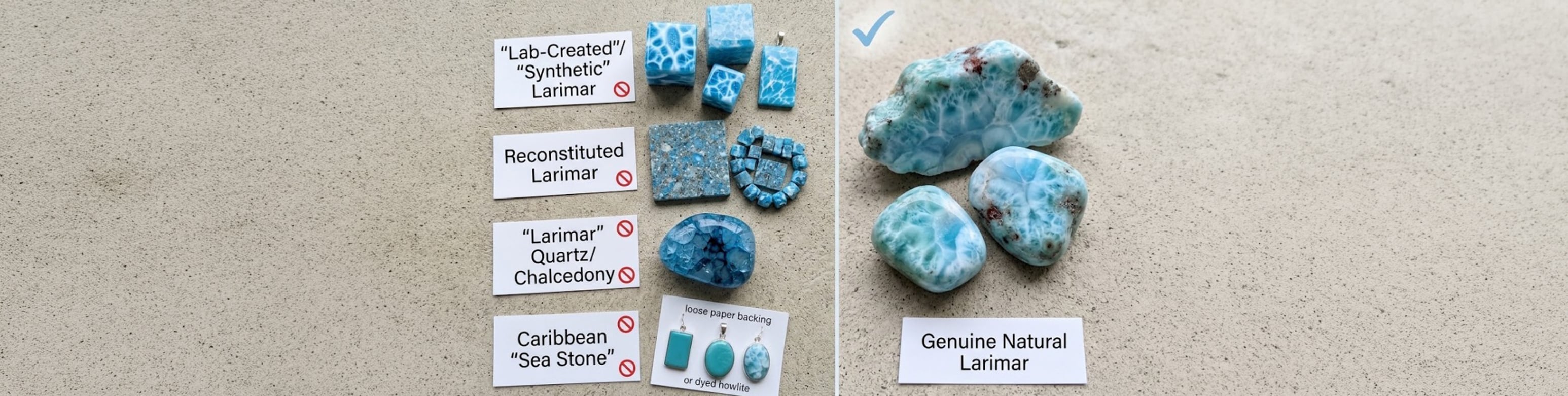
Online marketplaces are full of creative naming conventions intended to bypass search filters and mislead casual buyers. Always watch out for these red-flag terms:
"Lab-Created" or "Synthetic Larimar": Because pectolite is not yet possible to grow synthetically, no genuine lab-created Larimar exists on the commercial market. Anything with this label is usually resin.
"Reconstituted Larimar": This refers to mineral scraps and crushed rock dust held together with colored epoxy, not a solid, natural gemstone.
"Larimar Quartz": Larimar is a rare variety of pectolite, not quartz. Any listing using this title is selling dyed quartz or colored chalcedony.
"Caribbean Sea Stone" or "Atlantis Stone": While occasionally used as historical nicknames, these trade terms are frequently deployed by dishonest sellers to avoid legally guaranteeing that the item is authentic Dominican pectolite.
The Rise of Resins & Synthetics: How Close Are They Getting?
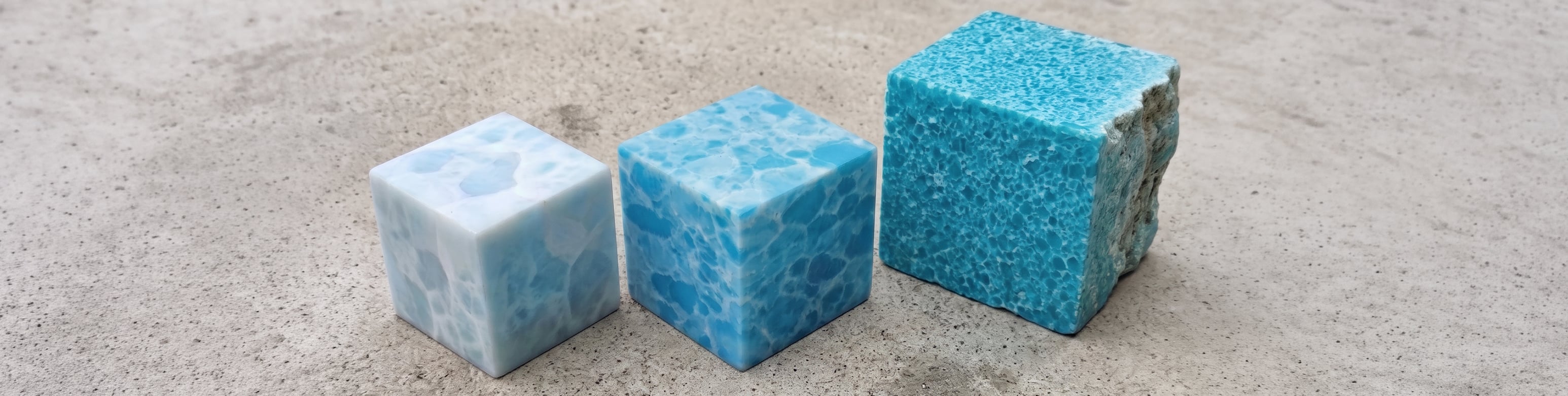
As Larimar’s popularity and rarity have surged, counterfeiters have moved far beyond cheap, painted plastic. Today’s market is flooded with engineered resins, poly-ceramics, and reconstituted block material designed to mimic the Caribbean water effect right down to the marbling. At first glance—especially in a tiny smartphone photo on a marketplace—these synthetics look stunning. But when you examine them with an educated eye, their perfection gives them away every time.
Key Visual Tells of Resin & Synthetic Larimar
A hard line vs. The "Soft Cloud": Look closely at the boundaries between the blue islands and the white webbing. In resin, the borders are razor-sharp, almost like someone drew jigsaw lines with a fine white pen or marbled wet paint. In Real Larimar: The transition is organic and gradient. The blue gently softens into cloudy, milky white fibers, resembling seafoam or cirrus clouds drifting across the sky rather than sharp cellular walls.
The Too Perfect Flawlessness: Natural Larimar forms deep inside volcanic fissures under extreme tectonic shifts. It almost always carries natural birthmarks: faint rusty-brown hematite specks, translucent grayish quartz pockets, calcite fractures, or olive-green basalt host rock.High-end synthetic blocks are sterile. They maintain flawless, uninterrupted neon-blue tones with uniform cellular spacing from front to back and corner to corner. If a piece looks like a pristine digital render or a swimming pool tile, it was made in a mold, not a mountain.
Pattern Depth (Flat Marbling vs. 3D Silky Chatoyancy): Because they are made from dyed resin layers, the white webbing sits on a single, shallow 2D plane. Real Larimar: Pectolite grows in needle-like crystal bundles called spherulites. When you tilt real Larimar under direct sunlight, you will notice subtle light refraction—a slight silky shimmer (chatoyancy) deep inside the stone that shifts as you rotate it. Resins remain flat and lifeless under moving light.
Weight and Temperature: Real Larimar is a dense, heavy mineral. It feels noticeably cool, substantial, and stone-heavy in your palm.Synthetic resin and acrylics have roughly half that density. A large cabochon or statement pendant will feel surprisingly lightweight, warm up instantly against your skin, and sound like a hollow plastic token if tapped gently against a table.
The 4-Point Photographic Checklist
When browsing online listings, open high-resolution photos in a new tab, zoom in to 200–300%, and inspect the stone for these critical visual cues:
1. The "Turtle Back" Cellular Matrix
Larimar crystallizes in spherulites, which are radiating, needle-like fibrous clusters of pectolite. In clear photography, this creates an unmistakable webbed or "turtle back" appearance where distinct islands of sky-blue or deep teal are enclosed by crisp, semi-translucent white borders. Imitation stones show flat, smooth color transitions or blended marbling rather than defined cellular boundaries.
2. Inclusions and Matrix Color
Natural Larimar is a volcanic mineral that often hosts harmless trace elements. There are nearly always trace inclusions or irregularities in the pattern of natural stone. If the cracks or veins look noticeably darker than the body of the gem, dye has concentrated in those fractures.
3. Depth Versus Flat Color
While most Larimar is opaque, high-grade stones can be semi-translucent. However, genuine Larimar always retains a silky, fibrous internal texture that interacts with light like sunlight rippling through shallow Caribbean water. Avoid pieces that look completely flat like blue plastic or entirely uniform like tinted bottle glass.
4. Check for Repeating Patterns
Genuine Larimar is one-of-a-kind; no two cut stones share the same pattern. If a shop sells multiple quantities of an item showing the exact same or very similar pattern, it is likely a mass-produced resin fake.
What to Do When Your Order Arrives (Safe Home Tests)
Never test a piece using a lighter, a hot pin, or a sharp scratch test, unless you are OK with potentially damaging or destroying your piece. These methods ruin authentic stones and automatically void your return privileges. Instead, verify your purchase using three safe, non-destructive steps:
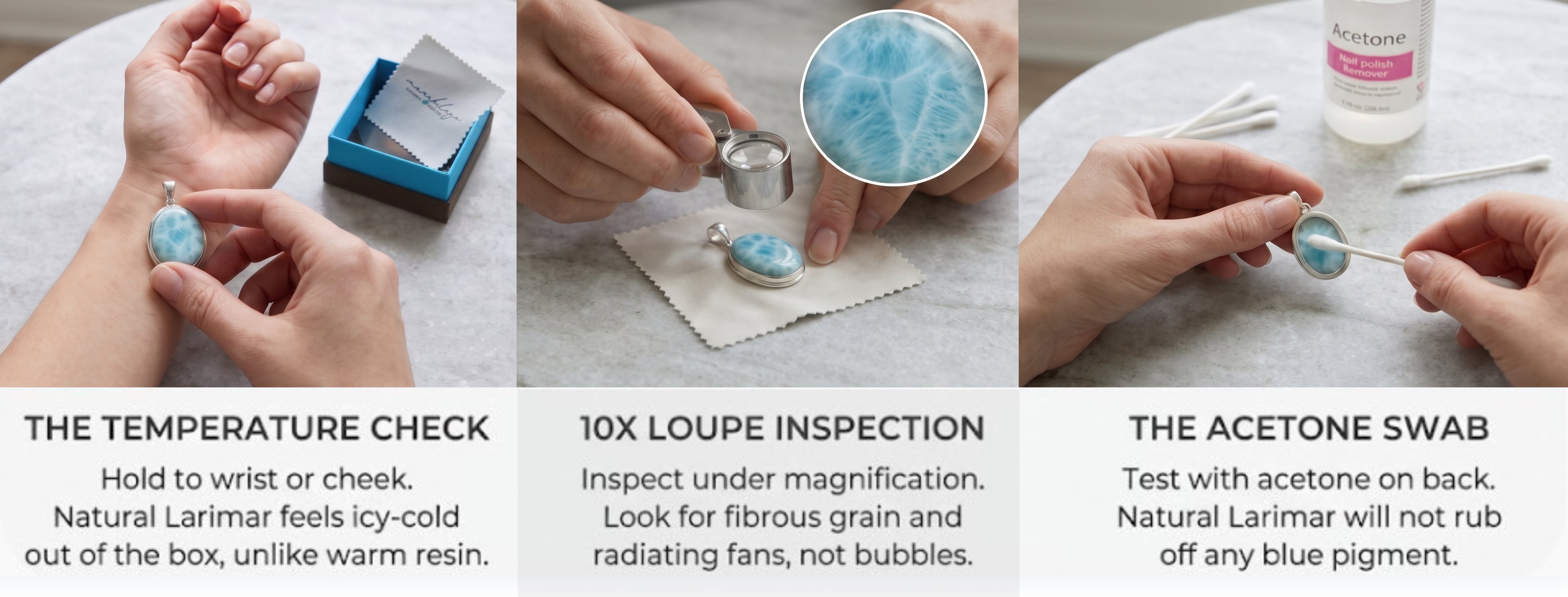
The Temperature Check: Natural minerals possess high thermal conductivity. Hold the stone against your cheek or the inside of your wrist right out of the box. Real Larimar feels cold to the touch, whereas plastic or resin warms almost immediately to ambient and body temperatures.
The 10x Loupe Inspection: Examine the stone under magnification. Genuine Larimar exhibits a distinctive fibrous grain and radiating crystal fans. In contrast, resin or glass pieces reveal smooth molded planes, flat pigment particles, micro-bubbles, or color patterns with distinct, sharp boundaries.
The Acetone Swab: Dip a cotton swab lightly in pure acetone or standard nail polish remover, then gently touch an inconspicuous area on the back of the stone. If any blue pigment rubs off onto the cotton tip, the stone has been chemically dyed.
Frequently Asked Questions
Where does authentic Larimar come from?
Genuine Larimar is found in only one location in the world: a single square-kilometer region in the Barahona province of the Dominican Republic.
Can Larimar be created in a laboratory?
No, there is currently no commercially available lab-created or synthetic Larimar. Products marketed as "lab-created" or "synthetic" are typically colored resin or glass imitations.
Is the hot needle or lighter test safe for testing Larimar?
No, heat and scratch tests can permanently ruin genuine gemstones and will void your return options. Stick to non-destructive tests like the temperature test, magnification loupe inspection, and acetone swab test.
Are the Larimar mines in the Dominican Republic closed?
No, the mines in Los Chupaderos, Barahona, remain active, though mining conditions are hazardous and yield fluctuates seasonally (especially during rainy periods). High demand and strict local control can make supply tight, but authentic mining operations continue.
Why does genuine Larimar range from light blue to deep blue or green?
Natural Larimar gets its vivid blue coloration from trace amounts of copper replacing calcium in the pectolite structure. Variations in mineral composition, oxidation, and red/brown iron or white calcite inclusions produce a wide spectrum of natural colors, ranging from soft translucent blue and vibrant Caribbean sky-blue to deep blue-green hues.
Why is authentic Larimar significantly more expensive than imitations?
Because genuine Larimar is extracted by hand from a single small deposit on Earth, high-grade gemstone rough is scarce. Authentic sterling silver jewelry requires skilled lapidary work to cut and set each unique stone, whereas synthetic resin, glass, or dyed minerals are cheaply mass-produced in factories.
How can I verify Larimar jewelry bought on a Caribbean vacation or cruise ship?
Examine the stone using the same 4-point photographic/visual checks: look for a distinct turtle-back cellular matrix, non-dyed matrix lines, and organic depth. You can also perform safe home tests like checking thermal conductivity (it should feel icy cold initially) and applying an acetone swab to the back to ensure no surface dyes rub off.
What is the difference between bezel-set and glued Larimar settings?
Quality jewelry craftsmanship uses metal bezels that securely fold over and physically hold the cabochon in place. In contrast, cheap counterfeit or mass-produced imitations often rely solely on glue or epoxy to attach plastic/resin pieces to metal backings, which can loosen or degrade over time.
Discover the World of Larimar
Guides, insights, and inspiration to help you choose, understand, and care for this rare Caribbean gemstone.
What is Larimar
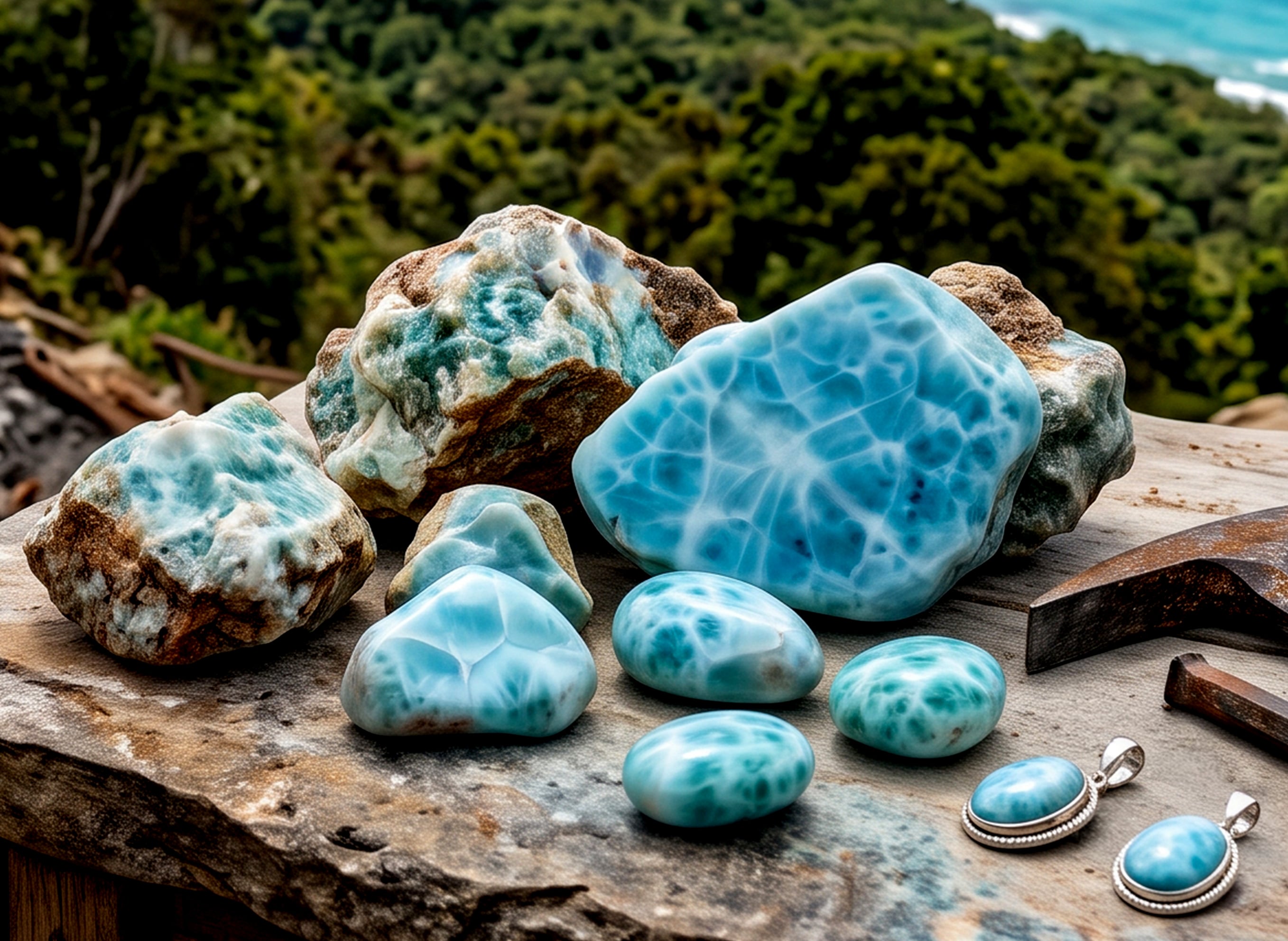
Explore the origins, geology, and unique volcanic history of the rarest Caribbean gemstone on Earth.
Read the Article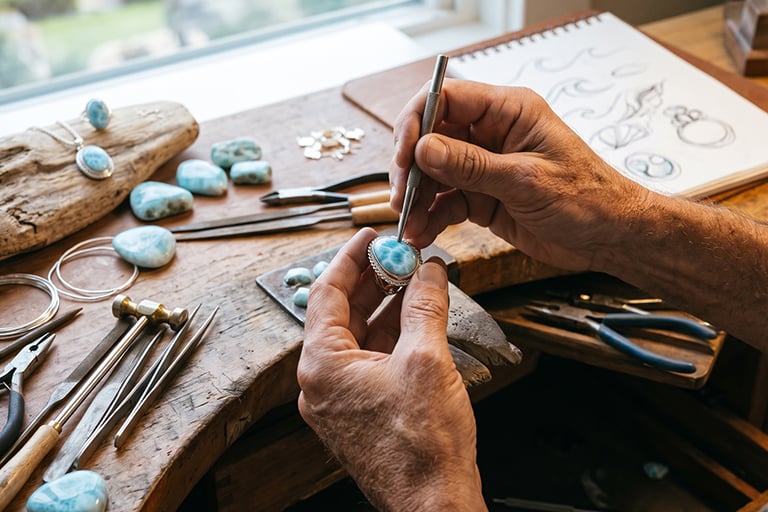
About Marahlago
Learn how our family-owned studio pairs the top 3% of natural Larimar with custom-engineered solid sterling silver.
Read the Article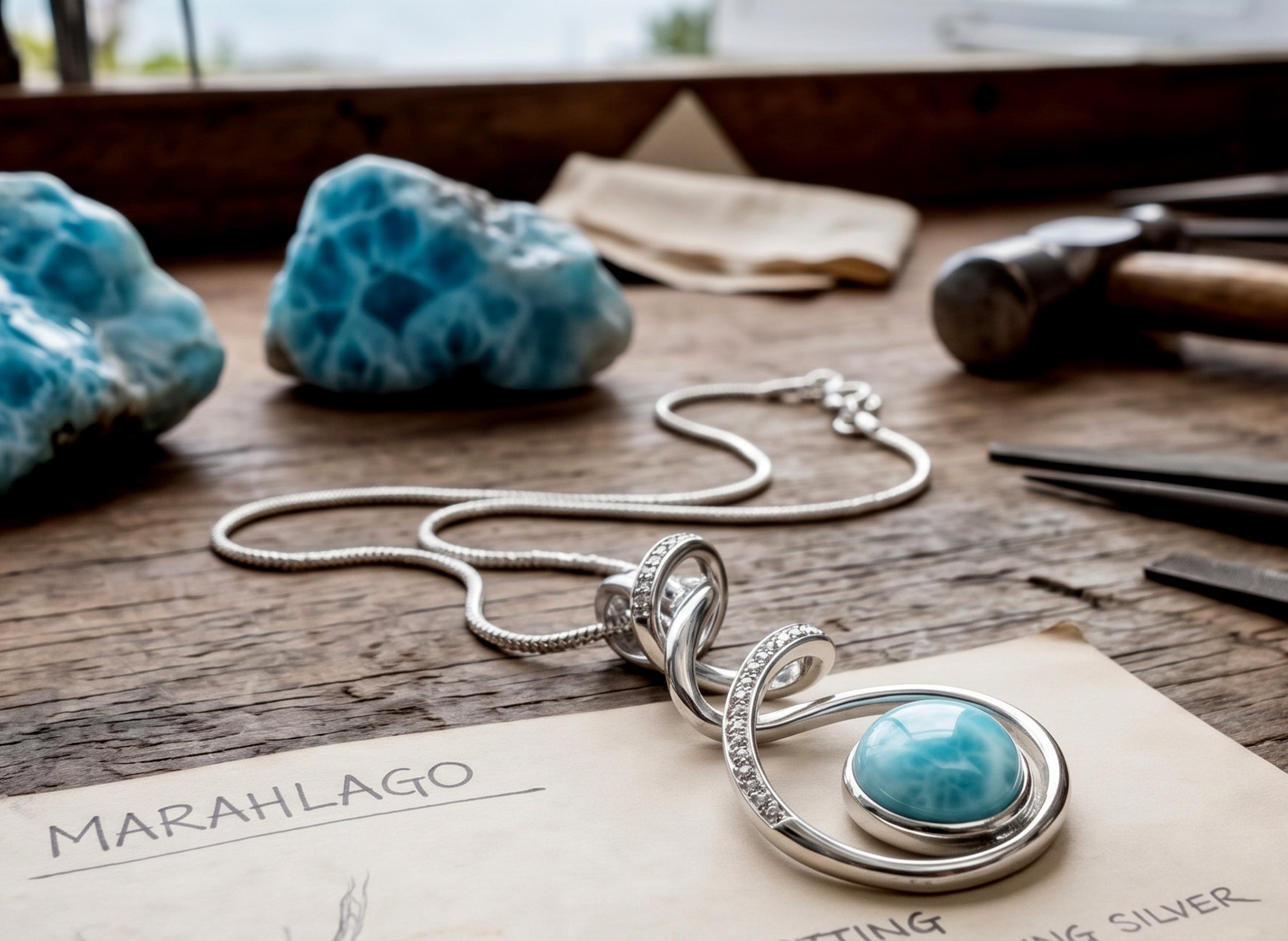
Why Choose marahlago
Discover over 25 years of artisan design, ethically sourced Dominican gems, and heirloom silver craftsmanship.
Read the Article
Larimar Care and Cleaning
Keep your Larimar jewelry looking beautiful for years to come with simple care tips, cleaning methods, and storage advice.
Read the Article